

Why Buying Canadian Office Furniture Makes More Sense Than Ever in 2026

The cross-border trade environment has shifted dramatically over the past year, and procurement teams responsible for office fit-outs, expansions, and workspace refreshes are feeling it.
Section 232 tariffs on lumber, upholstered furniture, and cabinetry came into effect in October 2025. While a planned escalation to 30% on upholstered goods and 50% on cabinetry was paused at the eleventh hour on New Year's Eve, the existing 25% duty remains in place on non-USMCA-compliant goods.
Trade policy used to be a footnote in capital procurement. Now it's a line item.
For Canadian businesses planning office fit outs in 2026, this volatility is forcing a question many didn't have to think hard about a few years ago: where is your furniture actually made, and what happens to your project budget if the tariff landscape shifts mid-build?
The answer, increasingly, is to buy Canadian. Not as a patriotic gesture, but as a practical hedge against supply chain disruption — and because Canada's contract furniture industry is genuinely world-class.
The risk side of the equation
Office fit-outs are typically planned 12 to 18 months out. Specs get locked, budgets get approved, and rollout happens in waves as floors, departments, or sites come online. That timeline is brutally exposed to mid-stream tariff changes. A 25% surcharge that lands between specification and delivery doesn't just trim margin — it can blow through contingency entirely on a six-figure order.

Sourcing from Canadian manufacturers that meet USMCA rules of origin removes that exposure for projects within Canada. Lead times are measurable in weeks rather than months. Freight is regional rather than transoceanic. Post-installation service — replacing a damaged panel, swapping a chair mechanism, adding workstations to match a hiring plan — is a phone call to a Canadian factory rather than a customs negotiation.
Federal procurement is signalling the same direction. The Build Canada framework launched in 2025 already includes Buy Canadian sourcing requirements for housing programs, and pressure is mounting to extend those preferences more broadly. Private-sector procurement teams are watching, and in many cases moving ahead of policy.
The quality side — and this part gets understated
There's an old assumption in commercial procurement that global brands set the standard and everyone else competes on price. In office furniture, that hasn't been true in Canada for a long time.
The Canadian contract furniture industry has built genuine depth. BRC produces panel systems and modular workstations engineered for high-density Canadian floor plates.
Rouillard, out of Quebec, makes seating that consistently competes at the upper end of the market on craftsmanship.

Tayco, based in the Toronto area, builds workstations and casegoods specified across enterprise, government, and education accounts.

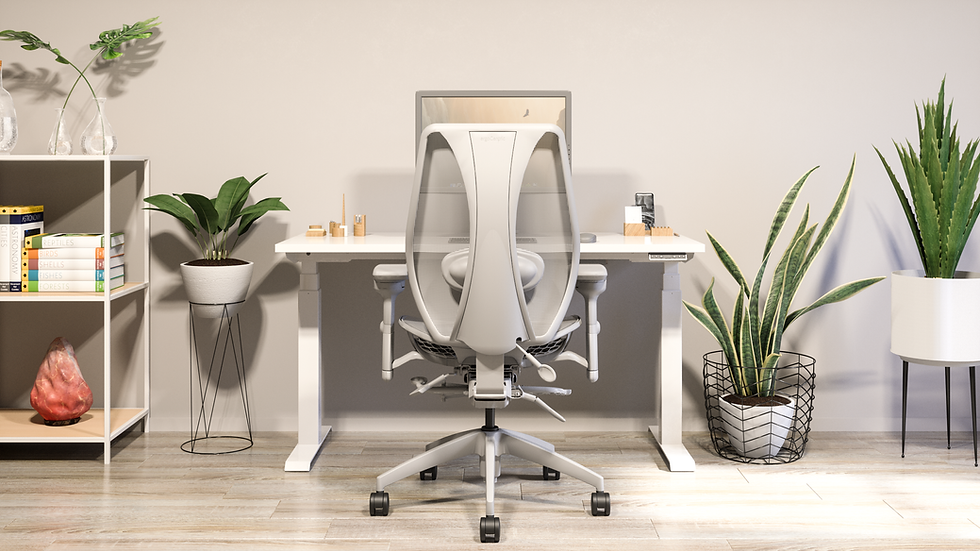
Ergocentric engineers task seating specifically for Canadian bodies, posture standards, and long-shift environments.
These are not consolation brands. They win specs against the global names on technical merit, not just cost.
Canadian manufacturing also brings practical advantages that show up in real fit-out projects: shorter and more predictable lead times, the ability to do site visits and factory walk-throughs, customization that doesn't require an offshore tooling cycle, and warranty service that doesn't disappear behind a customs broker. For furniture that has to perform across a 10- to 15-year usable lifespan in a high-traffic commercial environment, those service realities matter as much as the spec sheet.
There's also a sustainability dimension increasingly showing up in RFPs. Domestic production means a smaller transport footprint, easier verification of materials sourcing, and alignment with the LEED, WELL, and corporate ESG reporting frameworks more clients are now measuring against.
What this means for your next project
If you're scoping an office fit-out, relocation, or significant furniture refresh in 2026, the tariff environment is a reason to take a hard look at where your specifications are pointing. A Canadian-anchored furniture package isn't a compromise on quality, design, or specification flexibility. With the right manufacturer mix — and a dealer who knows the lineup — it's the more defensible, more predictable, and often the better-performing option.
That's what we focus on at Canadian Furniture Group. We work with the country's strongest contract manufacturers to plan, specify, and install office environments built for the way Canadian businesses actually operate.
If you have a project on the horizon and want to see what a Canadian-built solution looks like for your space, request a project estimate and we'll walk through it with you.

